Lisa Harris & Alan Johnston: Fiadh Irish Wolfhounds
This feature is part of an ongoing series highlighting trusted members of the Ireland Travel Planning Tips Facebook Group business networks. These tourism professionals are passionate about helping visitors experience Ireland in a more authentic and stress-free way.
How did Fiadh Irish Wolfhounds begin, and what inspired the two of you to turn your love of Irish Wolfhounds into a business? And what does the name “Fiadh” mean and why did you choose it?
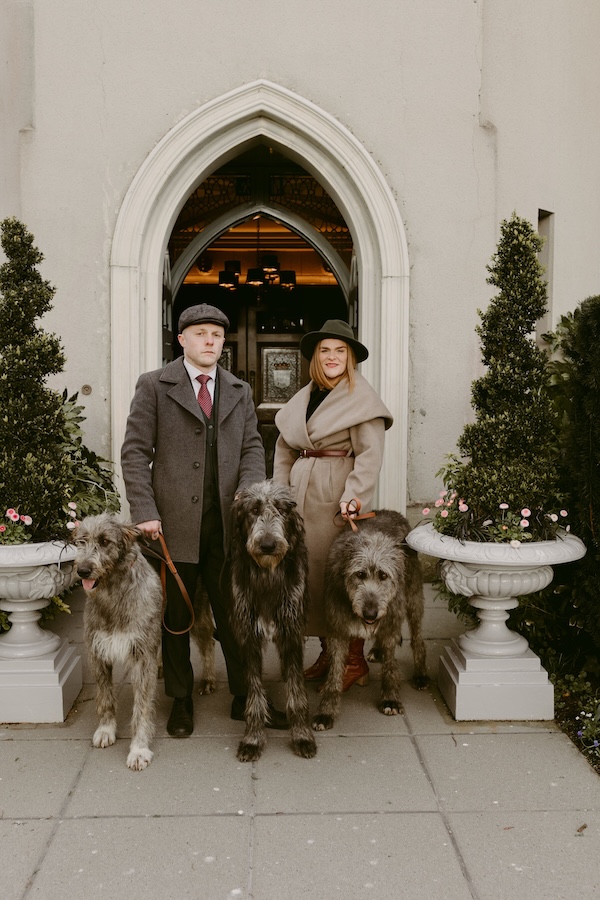
Fiadh really grew from our love of the Irish Wolfhound long before it became a business. We’ve always been fascinated by them — not just because of their incredible size, but because of their nature. They are enormous dogs with incredibly gentle, kind souls, and the more time we spent with them, the more interested we became in their history, their place in Irish culture and the importance of preserving the breed.
We realized that we had something quite special here.
We live in County Clare, surrounded by some of the most dramatic scenery and history in Ireland, and we had these incredible Irish dogs as part of our everyday lives. Fiadh grew naturally from wanting to share that with other people.
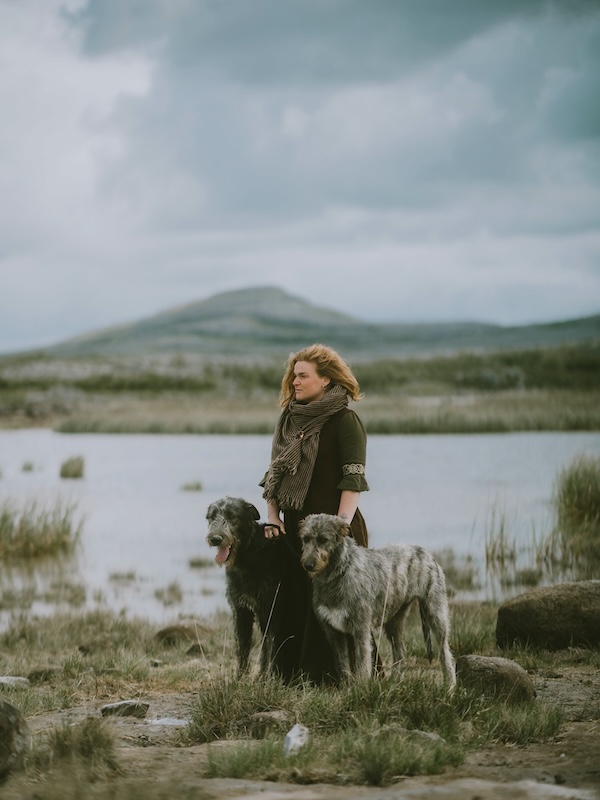
The name Fiadh is an Irish word associated with something wild or a wild creature, which felt particularly fitting for an Irish breed whose history is so closely connected with the landscape, folklore and heritage of Ireland.
What started as a love of the dogs gradually became a way of introducing people from all over the world to the Wolfhound, while also sharing the history, stories and landscapes of County Clare.
Irish Wolfhounds have such a fascinating history in Ireland. What are some of the stories or legends surrounding the breed that you most enjoy sharing with visitors?
There are so many stories surrounding the Irish Wolfhound that it’s difficult to choose just a few.
We love talking about how highly regarded these dogs were in ancient Ireland. They weren’t simply kept as pets; they were valuable working and hunting dogs and were associated with warriors, chieftains and kings. Their size and strength gave them an almost mythical status.
The stories from Irish mythology are particularly fascinating, too.
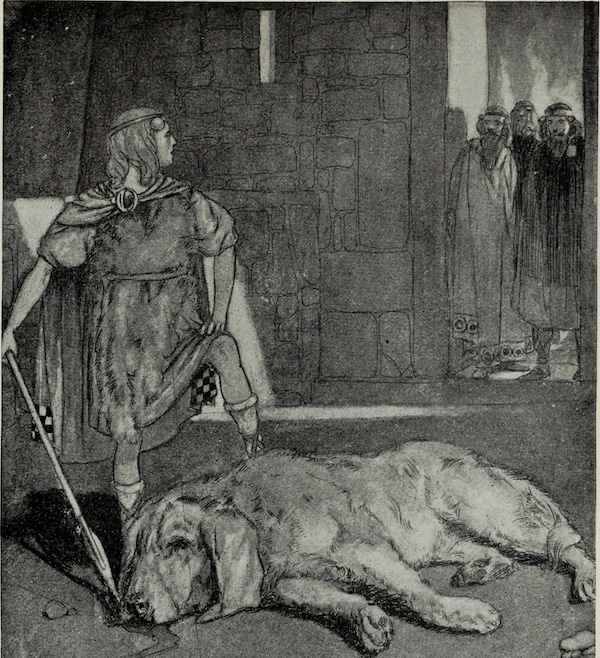
One of the best known is the story of Gelert, although that particular legend is Welsh rather than Irish, so we always make that distinction with visitors.
Ireland has its own rich tradition of Wolfhound stories, including the famous tale of Cú Chulainn, whose name translates roughly as “hound of Culann.” The idea of the hound being so important that it becomes part of a person’s identity is a wonderful example of how deeply dogs were woven into Irish culture.

We also enjoy talking about the fact that these dogs were once exported as gifts to royalty throughout Europe. They became so sought after that their numbers eventually declined dramatically.
For us, the history makes the modern Wolfhound even more interesting. When you stand beside one today, you’re looking at a breed that has been part of Irish history for centuries.
For someone who has never encountered an Irish Wolfhound in person, how would you describe the breed? What tends to surprise people when they meet one for the first time?
The first thing people notice is obviously the size — photographs really don’t prepare you for just how enormous an Irish Wolfhound is.
But the thing that surprises people most is usually how gentle they are.
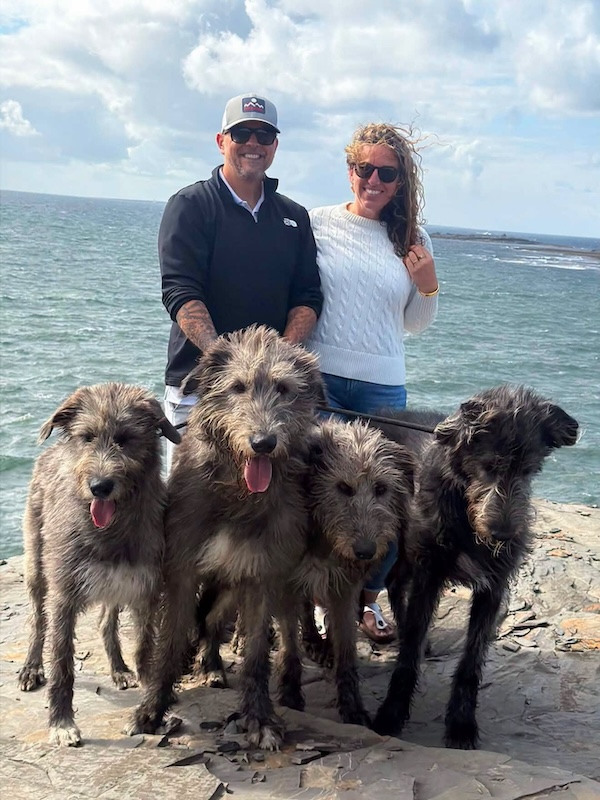
They are incredibly calm, affectionate and people-oriented dogs. Despite looking like something that could have walked straight out of an ancient Irish legend, they tend to be complete softies.
People also expect them to be intimidating because of their size, but within minutes they’re usually laughing because a Wolfhound has its head on their shoulder, leaning against them or trying to climb onto their lap despite being far too big.
They’re also surprisingly funny. They have huge personalities and can be absolute eejits. Living with them is much less like owning a collection of enormous dogs and more like living with a group of giant, slightly ridiculous family members.
Your dogs seem to be very much a part of your family. Can you introduce us to some of the individual Wolfhounds that guests might meet and tell us a little about their personalities, as well as what it’s like living with the dogs?
Every Wolfhound has its own completely different personality, which is one of the things we love most about them.
Ruairí is our giant silly eejit. He is a complete goofball and absolutely loves attention, particularly a good butt scratch. He’s the sort of dog who can make people laugh without actually doing anything deliberately funny.
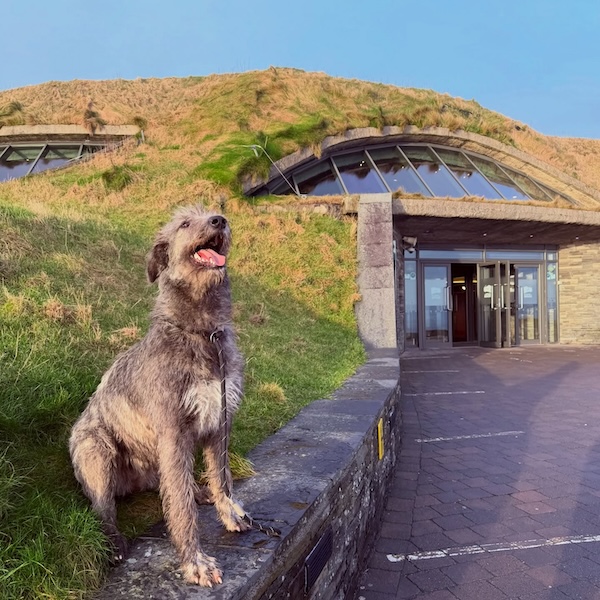
Mira is the boss. She’s our matriarch and definitely knows it. She’s independent, calm and very much a Mammy’s girl. She’s gentle when she’s being stroked but fierce when she feels she needs to be, and she keeps the rest of the pack in line.
Saoirse is our affectionate little messer. She’s got a slightly feral side to her and absolutely loves people — preferably close enough to give them kisses. If she decides you need a kiss, you’re getting one.
Lincoln, Saoirse’s brother, is the dark and handsome one. He’s incredibly sweet-natured but absolutely must investigate every smell he comes across. A Wolfhound walk with Lincoln can sometimes become an investigation into every blade of grass in County Clare.
And that’s really what living with them is like: huge, hilarious, affectionate and occasionally completely lunatic. They take over the house, the furniture and pretty much every available space, but they’re family first and foremost.
What is it that makes them such wonderful companions for the kind of experiences you offer?
Wolfhounds have an incredible ability to connect with people.
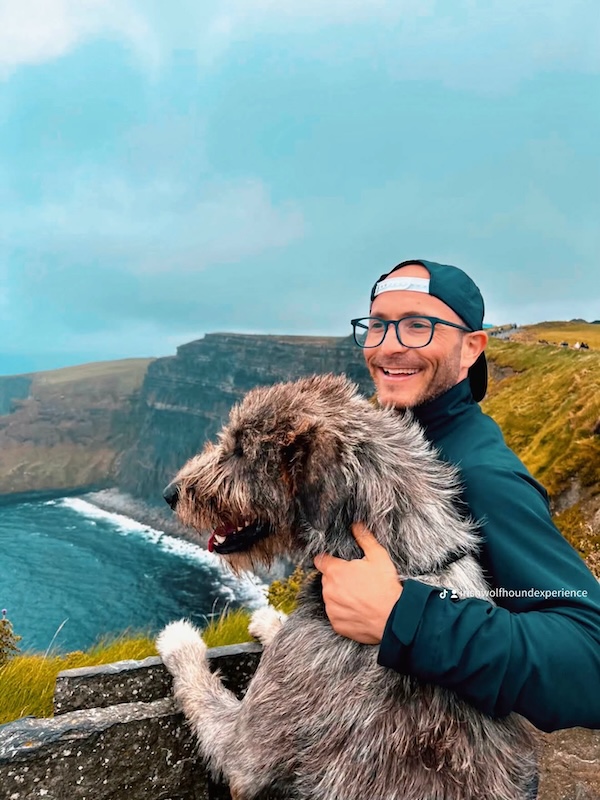
They’re naturally calm and gentle, and they seem to make people slow down. You can arrive as a complete stranger and within minutes you’re standing beside a Wolfhound, chatting away, stroking them and laughing.
They also break down barriers. People who might normally be quite reserved suddenly have something to talk about. We’ve had people from all over the world share stories about their own families, pets and lives with us simply because a Wolfhound has started a conversation.
That’s something we never really anticipated when we started. The dogs have introduced us to people from all over the world, and some of those connections have become incredibly special.
What can visitors expect from a typical Fiadh Irish Wolfhound experience?
They can expect much more than simply meeting a big dog.
The dogs are obviously at the heart of it, but we want people to experience Ireland through the Wolfhound.
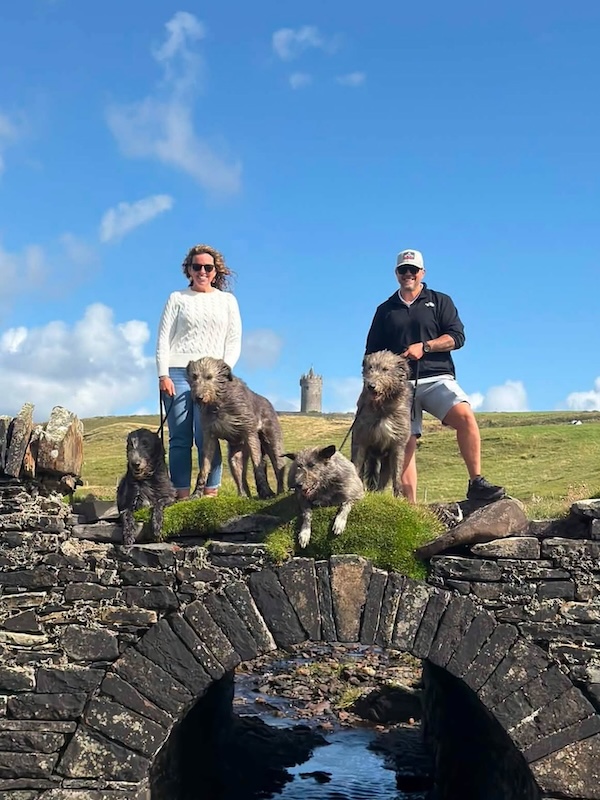
Depending on the experience, we’ll walk together through some of County Clare’s most spectacular landscapes while talking about the history and heritage of the area, Irish Wolfhounds, Irish culture and folklore.
There is plenty of time to stop, take photographs, ask questions and, of course, spend time with the dogs.
We don’t want people to feel like they’re being rushed from one photo opportunity to the next. It’s about getting out into the landscape, walking alongside these incredible Irish dogs and experiencing the place properly.
You combine the Wolfhound experience with some of County Clare’s spectacular scenery and history. What are some of your favourite places in the Burren or along the Wild Atlantic Way to experience with the Wolfhounds?
We’re incredibly lucky because County Clare gives us so much to work with.
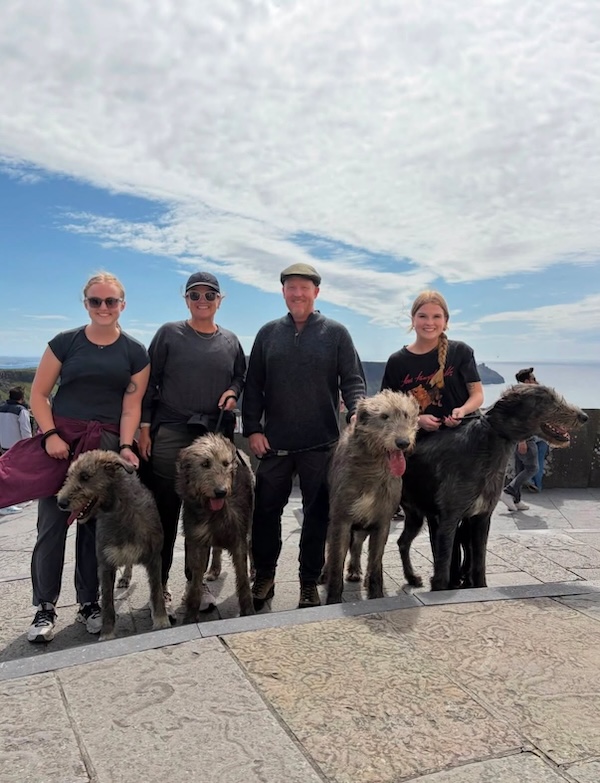
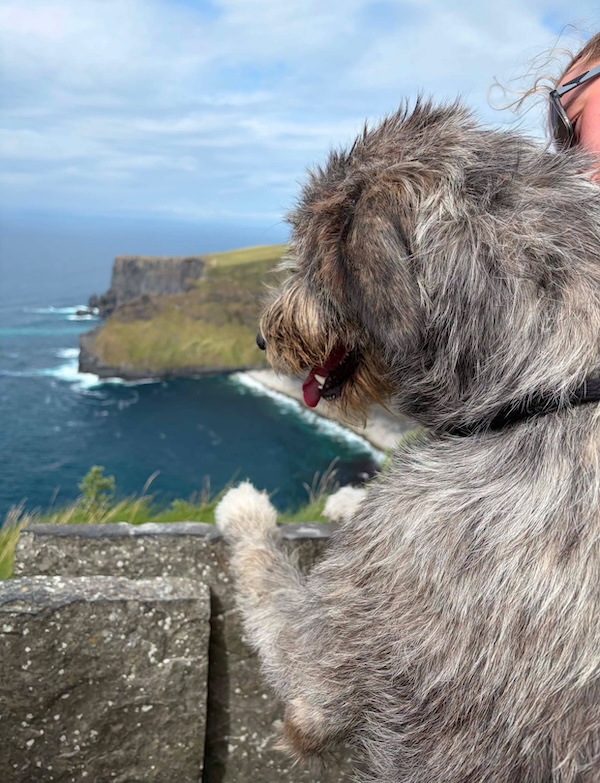
The Cliffs of Moher are an obvious one. There’s something pretty extraordinary about standing beside an Irish Wolfhound with the Atlantic crashing below you and the cliffs behind you. It feels like the dogs belong in that landscape.
We also love the Burren, particularly around Mullaghmore. It’s completely different from the cliffs — ancient stone, open landscape, turloughs and that incredible sense of wilderness.
Doolin is another favourite because it has that raw, wild Atlantic character. The village, Doonagore Castle, the cliffs and the sea all come together to create something that feels unmistakably Irish.
And that’s really what we look for in a location. We’re not just looking for somewhere pretty to take photographs. We want somewhere with character, history and a sense of place — somewhere where the Wolfhounds feel like part of the landscape rather than simply being brought there for a photo.
What do visitors seem to enjoy most? Is it the dogs, the scenery, the history and folklore, or simply having the chance to slow down and experience Ireland a little differently?
Honestly, it’s probably the combination.
The dogs are what initially draw people in, but the experience becomes much bigger than that. We’ve had visitors who arrived wanting nothing more than a photograph with a Wolfhound, and by the end they’re fascinated by the breed’s history, the landscape and the stories we’ve shared.
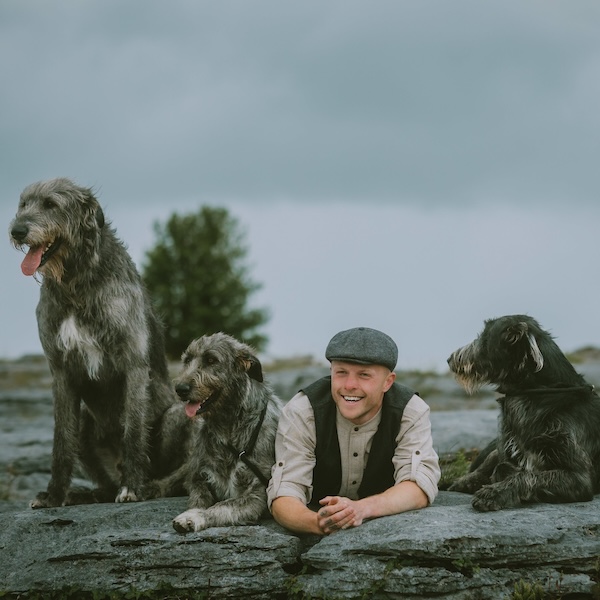
I think people also really enjoy having permission to slow down.
Ireland can be very fast-paced when you’re trying to fit everything into a holiday — drive here, see this, take a photograph, get back in the car. Our experiences give people a reason to stop for a while.
They can walk, talk, take in the landscape, meet the dogs and actually experience where they are rather than simply passing through it.
The welfare of your Wolfhounds is clearly central to the business. What measures have you put in place to make sure the experiences are enjoyable for both the dogs and your guests?
Our dogs’ welfare comes before the business, always.
We don’t believe the dogs should simply be treated as part of the product. They are our family, and if they’re not enjoying something, we don’t do it.
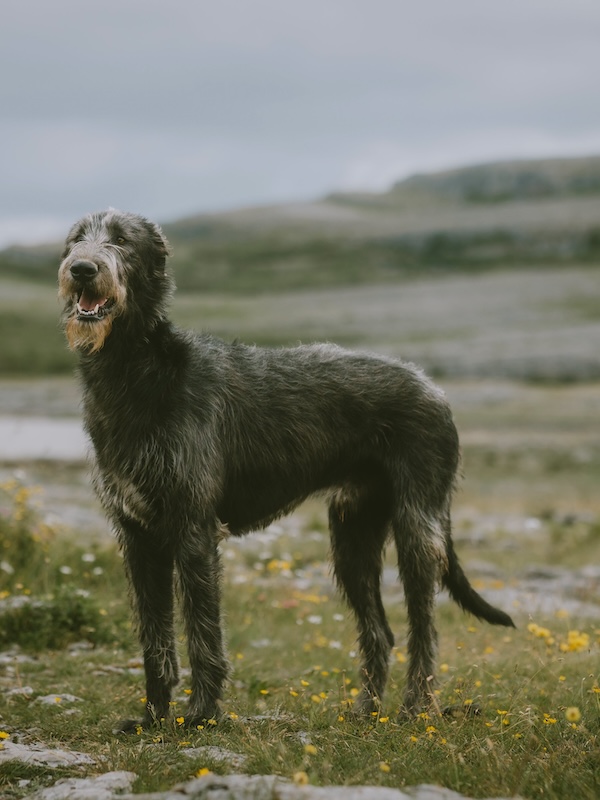
We keep groups manageable so the dogs aren’t overwhelmed, and we pay close attention to their behavior and body language throughout an experience. They have plenty of opportunity to rest, and we never expect them to keep interacting with people when they’ve had enough.
Weather is also hugely important with Irish Wolfhounds, particularly heat. We have strict limits around temperatures and will cancel or change an experience if conditions aren’t suitable.
We’re also very conscious that these are giant dogs with specific physical needs. The aim is for the dogs to enjoy meeting people and exploring the landscape just as much as the visitors enjoy meeting them.
If the dogs are happy, relaxed and enjoying themselves, the experience is naturally better for everyone.
Why do you think an Irish Wolfhound experience in Ireland should be on a visitor’s vacation itinerary?
Because it’s something they simply can’t experience anywhere else in quite the same way.
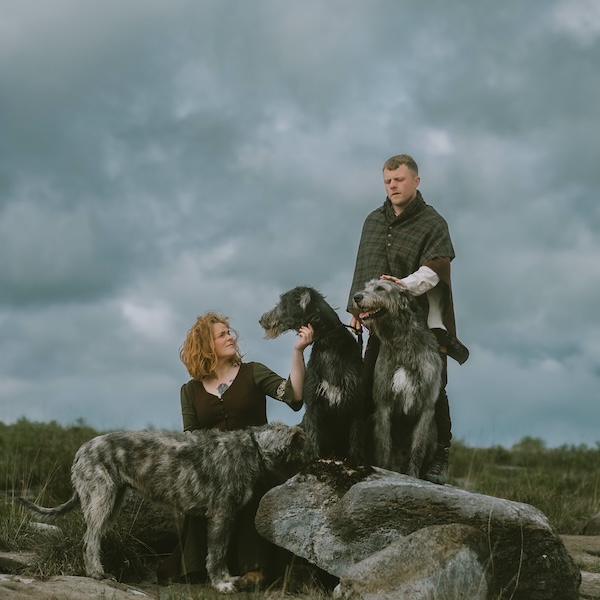
You can visit beautiful places all over Ireland, but standing in the Irish landscape beside one of Ireland’s most iconic native breeds adds another dimension to it.
The Wolfhound connects the visitor to Ireland’s history, mythology, landscape and culture in a very tangible way. You’re not just hearing about an ancient Irish breed — you’re standing beside one.
And for us, that’s what makes it special. It’s an opportunity to experience Ireland at a slower pace, meet the dogs, hear the stories, walk through the landscape and leave with a memory that is much more personal than simply ticking another attraction off a list.
If you could describe the Fiadh experience in three words, what would that be and why?
Wild. Authentic. Unforgettable.
Wild, because of the landscapes we explore, the Atlantic coastline and the Wolfhounds themselves.
Authentic, because this isn’t something we’ve created simply for tourists. These are our dogs, our home, our landscape and a breed that we’re genuinely passionate about preserving and sharing.
And unforgettable, because we see it happen all the time. People arrive having never met a Wolfhound, and they leave talking about the dogs, the places we’ve visited and the experience long after they’ve gone home.
That’s ultimately what we want Fiadh to be — something people remember as one of the experiences that made their time in Ireland truly special.
The friendly canines that make up Fiadh Wolfhounds are also available for special occasions like weddings. Email [email protected] to find out more.